
The Terracotta Warriors are China’s most famous attraction after the Great Wall of China. It is one of the most impressive archeological finds in history. An entire army of thousands of life-size clay warriors, horses and chariots were unearthed 35 metres under the ground.
Table of Contents
Terracotta Warriors of Xian
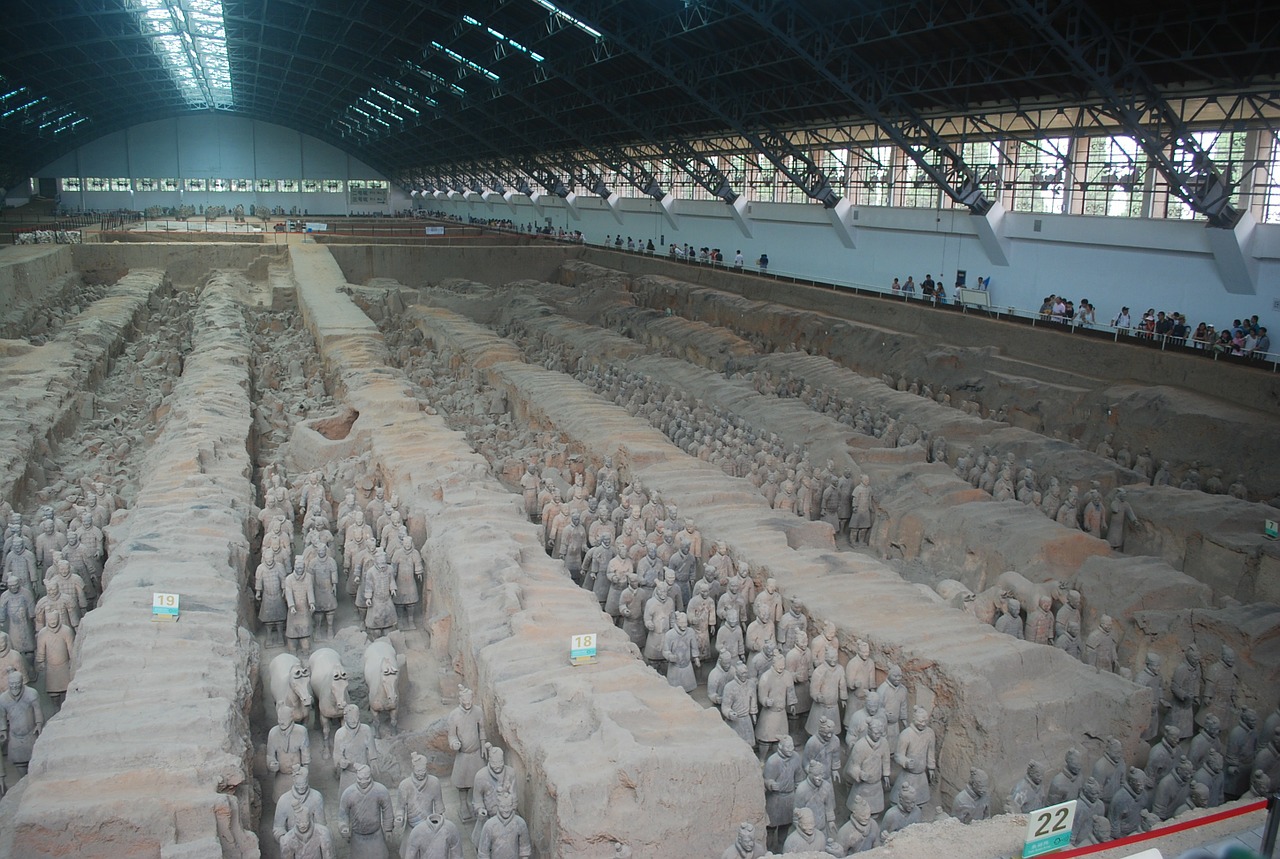
The Terracotta Warriors are amazingly lifelike and it feels as if they could simply wake up and start marching along as they did over two thousand years ago. Built by Emperor Qin Shi Huang, the first emperor of a unified China, this underground army lay undiscovered for over 2200 years. You may know this era better as The Qin Dynasty.
We had two different guides telling us two different stories. It was impossible to get our facts straight and even when looking things up, we couldn’t decide what was true. In reality, everything about the Terracotta Warriors is a mystery since the Terracotta Warriors had been buried for more than 2000 years. Really, anyone could make up whatever facts they wanted. But here are a few facts about the Terracotta Warriors that we got from our conflicting reports from our guides. You decide, Are they real or are they Memorex? (old person joke)
The Story Of The Terracotta Warriors
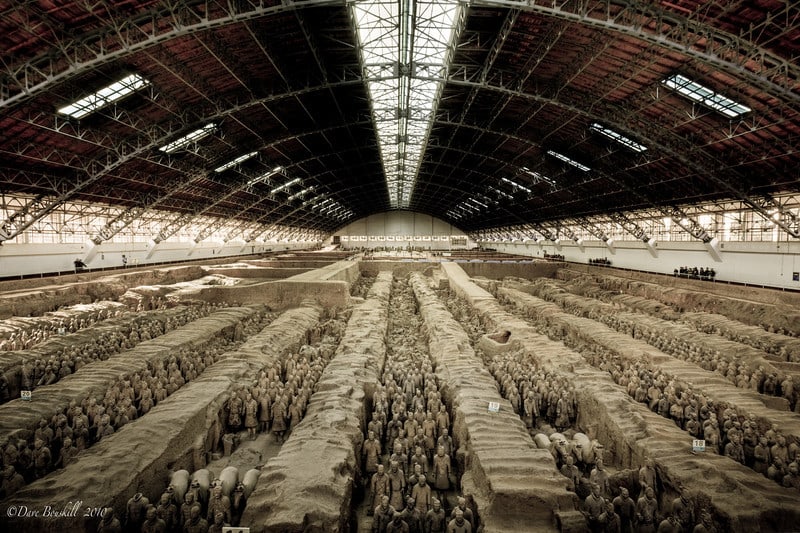
How on earth could the Terracotta Warriors disappear and remain hidden for two millennia when everyone knew it existed? Well, according to our guide, the tyrant Emperor Qin killed everyone that helped to build the underground army.
700,000 people were enslaved over the 38 years it took to build his self-indulgent monument. Our guide told us that those left who built the monument were killed to keep anyone from revealing its location. The craftsmen were buried alive and his 3,000 concubines were forced to self-sacrifice. Other people were just plain murdered. It was then buried and hidden from view.
Our guide claimed that millions of people died making this monument over nearly 40 years. In the end, nobody was left alive to tell anyone where the 8000 Terracotta Warriors and horses leading bronze chariots were buried. The clay warriors were all left undiscovered for centuries while they kept guarded the Emperor in his afterlife.
In Search of the Tombs
Many people tried over the centuries to find the tomb of the Terracotta Warriors and many failed. It was well hidden and even if you did find a way in, booby traps were set up to keep anyone from entering the mausoleum 35 meters underground. It was like something out of Indiana Jones and the Temple of Doom.
Emperor Qin’s Tomb is Also Toxic
Even today, our guide said that scientists cannot open Emperor Qin’s underground palace. They know it is there, but there is no way to open it because the Emperor is buried in mercury (they assume) an extremely toxic and dangerous gas. Even the water around the Terracotta Warriors is toxic and people in neighboring villages are encouraged not to drink it.
Until they find a way to safely open the chamber, China is stuck waiting and biding their time.
Terracotta Warriors Excavations
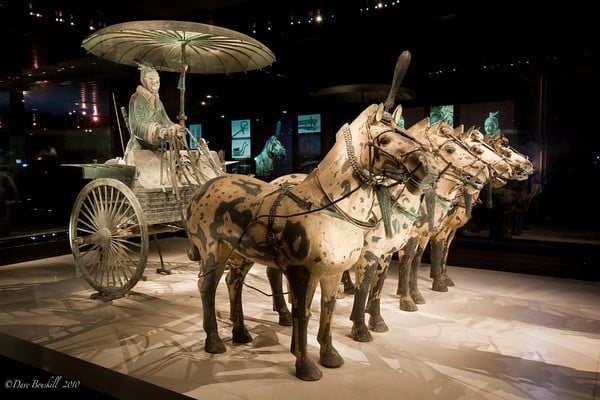
Right now, the Terracotta Warriors excavation is put on hold. All the original warriors were colorfully painted when they were unearthed, but soon after being exposed to the air, the colors disappeared and faded.
Nobody wants to unearth any more warriors until they figure out a way to preserve the paint. Apparently, they have found a way to preserve said paint, and are starting to unearth the remaining army.
Discovery Of The Terracotta Warriors
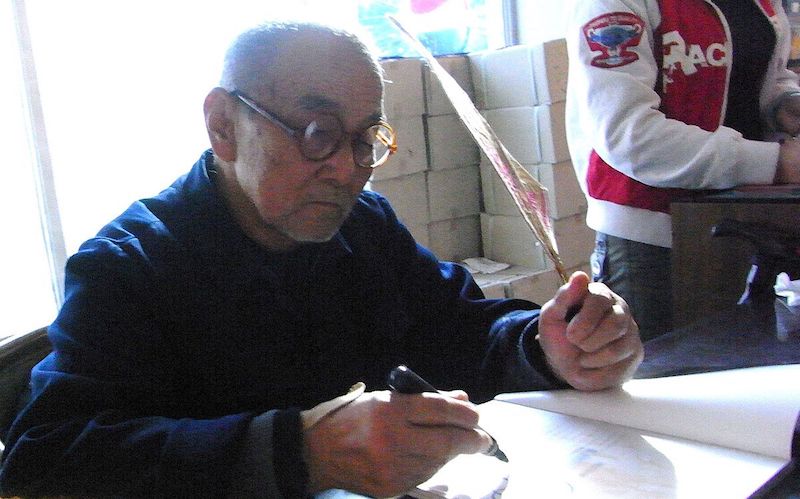
It was a farmer in 1974 that discovered the terracotta warriors while digging a well. This was back in the days of Chairman Mao and the farmer, Mr. Yang was given a mere 50 Yuan ($7.50) for making the most significant find of the 20th century.
Luckily times changed in China, and Mr. Yang received a monthly allowance from the government and even spent a couple of days a week at the museum to sign books. He died at the age of 81 in 2018.
He was there during our visit to the Terracotta Warriors in 2010, but pictures of Mr. Yang were strictly prohibited. Instead, you could pay a fee to have him sign your newly purchased coffee table book. (I got this one from Wikipedia)
The Terracotta Warriors excavation site has undergone a major restoration.
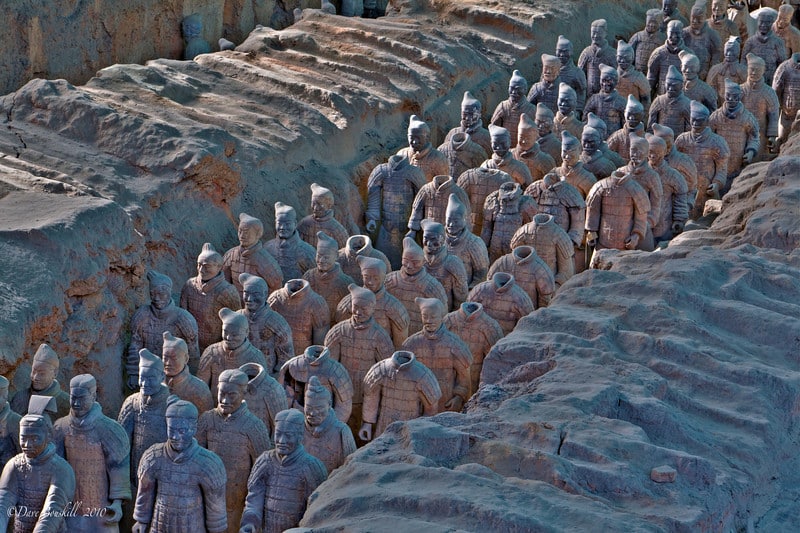
We were led through 3 different pits, the most impressive being pit number one of the Terracota Warriors. This is the largest pit containing 6000 life-size warriors standing in formation.
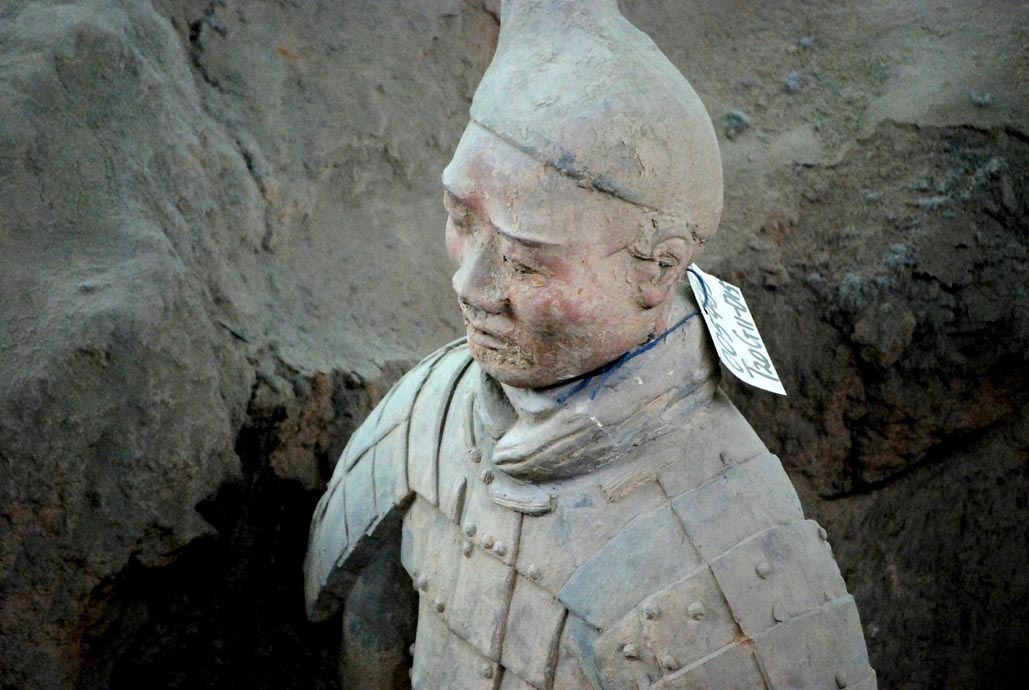
No two warriors’ faces are alike and the detail and craftsmanship that went into each piece are astounding. It is incredible to think that someone had the audacity to build such a massive monument. Each warrior has its artist’s name etched into its foot.
The artists of the Terracotta Warriors were threatened with death if their craftsmanship wasn’t up to par and were forced to leave their signatures so that their captors would know who built what. Unfortunately, they weren’t aware that they were going to be killed anyway.
Hot Tip for Terracotta Warrior Tour
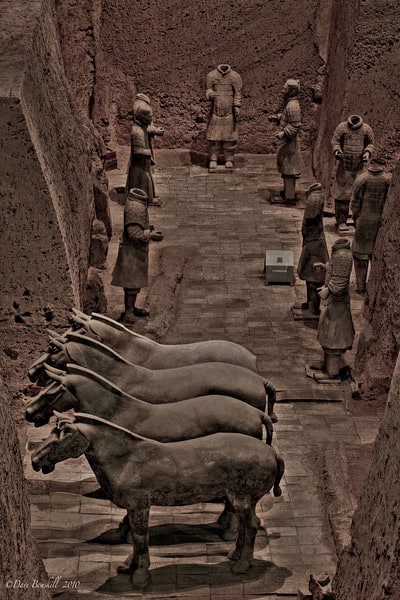
The other two pits of the Terracotta Warriors aren’t as impressive so make sure to take all your photos before moving on. We thought that each pit would become more impressive as we walked through but they become less impressive as you go.
We would suggest doing the door the opposite way around. Start at the museum, and then enter pits 3 and 2 and then save the best for last. That way you will know all about the story and what you are looking at.
Pit number two is largely unexcavated and pit three is believed to be the headquarters of the officers.
I searched the Internet to verify that I had my chamber numbers correct, people actually say that pit two is the most spectacular of the Warriors. We didn’t feel that way at all, in our opinion the most spectacular pit is number one.
Are the Terracotta Warriors authentic?
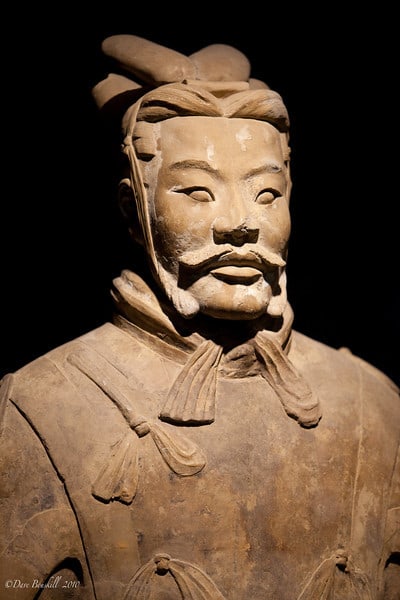
It is difficult to imagine what is real and what isn’t. Every warrior that is excavated is restored to perfection. There isn’t a chip or piece of clay missing from their face. We couldn’t help but think that there was barely anything authentic about them.
We wondered if any of them were original or if they were all replicas.
During our tour, we were told that the underground army had been raided at one point in time and peasants burnt it to the ground. This story contradicts everything we were told by the same guide. One minute she told us that everyone who knew about the Terracotta Warriors and the Emperor’s tomb were killed, and the next minute she tells us that peasants raided it and burned it to the ground.
Which story is true? We do not know. But if peasants burnt it to the ground, that means that people knew about the Terracotta Warriors and not everyone was killed.
In China, history seems to be interpreted differently depending on your guide.
In China, history seems to be interpreted differently depending on your guide. We were told that the archeologists are the only people allowed to use the clay from a nearby mountain to rebuild the warriors. Okay, so do the warriors we are looking at have anything original to them at all or are they completely rebuilt by the archeologists using the genuine mountain clay that our guide so often spoke about? We don’t know.
Unfortunately, I don’t have any way of researching because while writing this post we are currently in China and most of the Internet is blocked due to censorship. For now, I will blissfully accept anything that my guide tells me and believe it wholeheartedly.
While we had a fantastic guide traveling with us throughout China on our Intrepid Travel Tour, we had different local guides for each attraction and site that we visited. Our guide at the Terracotta Warriors was local and had many fanciful things to say. You can book tours to the Terracotta Warriors with Get Your Guide from Xi’ian


wow. Interesting to know all things. I think I really have to make plans to visit china to see the Terracotta Warriors myself. Thanks for sharing.
Hi Dave and Deb found your blog at planet D, interesting to known which way to go around the Terracotta Warriors. I’m planning to do some parts of China later in 2020. I want to do this independantly as I am not keen on doing on Mass trips with others as you don,t get enough time to explore thoughly. Me and my wife have travelled very extensively in the far east and have just done Myanmar Mandalay , Bagan and it,s amazing temple,s and Pagodos, and Yangon and Inley lake in the mountain. Just oganising another trip back to Hong Kong, Cambodia Siem Reap Phom Penn, Kuala Lumpa, Bali and Singapore . Although my daughter visited China a few year ago see thought it was differcult to be understood. I,m interested in visiting some out of the way places such as Fangjingshan in the Wulling Mountains which only came to light reasonly do think this would be easy enough to organise. Your comments would be very wecomed Best wishes from Dave and Ali
Only found out about the warriors when i watched a program about The Silk Road. I was amazed by this. Look as if they have all been turned to stone.. Comments are intresting and very helpful thanks.i will defos read up more.x
Been..seen..2016… If it looks like bullshit..smells like bullshit..then… Mercury easily tested for.. digging wells in a
‘poison” area conveniently exactly on the edge of the excavations..watching the “restoration” of so many pieces.. I could list so much.. but hey…your guide said so…so it must be true….”hand covers mouth..sneezes..ahh ahhh bullshit”
When you visited Xi’an, did you use a guide service or did you do the trip to see the TC warriors on you own? Public bus or private car?
We used a guide. We were on a China tour with Intrepid Travel. But I believe it is easy to book day tours. Get Your Guide offers them. We use them a lot.
Well worth visiting as it’s a great site, however I was told by a friend who was at a local university near Xian that these are all replicas based, of course, on the original statues.
That’s good to know Steve. We were sure that they had to be replicas. I just don’t think that these statues could have been in tact after listening the guide speak. It’s one thing to have the foundations of a building survive centuries, but the statues, I don’t think so. I agree with you though, Yes, it is a very impressive site.
I have certainly heard about these warriors, but did not know that the builders had been killed, as well as all those people. I will eventually make it, for sure!
Fascinating!!
I was so gutted that we didn’t get to see these whilst we were in China (one of the main reasons we went). We were crap at planning and found that you couldn’t just jump on a train whenever you wanted and would have had to wait 10 further days in Beijing just to get there.
I find the warriors really fascinating and going to wait a few years and see how much things have changed – maybe they will have been able to open the tomb!?!
Great write up 🙂
You will have to tell us how they are a few years from now. Our guide repeated many times “come back in a few years, things will be very different” I think that can be said for all of China. Things are changing quickly.
I studied this site in art history and ever since, have really wanted to see it! If I make it to China I’m definitely going here. I also can’t believe with all of the modern technology out there, they still can’t open the emeror’s tomb.
Hi Laura, I know it is crazy isn’t it. They worry not only about the toxic gases, but how everything will be destroyed if they open it as well. As far as our guide was concerned, they will be opening it soon. And they will be starting to excavate more warriors as well because they have figured out how to preserve the paint. Cool.
what a great guide — I didn’t get to see this when I went through last time. Need to get back there and hit it up.
History is so interesting… how it’s passed along in different places and by different people. But that’s one of the reason archaeology is so important – you can’t argue with old stuff buried in the dirt! Didn’t know about the mercury. What a fascinating place – would love to go there someday – much more now that you’ve taken me along w/you in this post!
Thanks Margo. We didn’t know about the Mercury either. It is extremely fascinating to see the work that went into the afterlife all those years ago. Life wasn’t all that different between Egypt and China on opposite ends of the world.
The first picture of the huge room is amazing and overwhelming at the same time. How awesome.
Wow, definitely something I’d love to see. What an amazing place… can’t imagine the time that went into that !!
Brooke, it is definitely worth going to. Just to see the scale of what went into this place so long ago. It is truly a feat of artistry and engineering. The guide kept telling us to come back in a few years, they will have figured out how to preserve the paint and start excavating the soldiers again, and maybe they will open the tomb soon. Although our Intrepid Guide Karen said it will be much long than a few years for the tomb, but you never know. 🙂
Oh, also, here’s my post from visiting the Terra Cotta warriors, a different perspective.
http://odysseusdrifts.blogspot.com/search/label/China_Xi%27an
Thanks for sharing, I am glad you survived your first overnight sleeper train.
Haha, I heard the opposite story about an invading army (or peasants?) trying to burn the place down, but only succeeding in knocking over some of the statues and causing sufficient disarray to the place that it was ignored from then on and got covered by dirt, plant growth, etc. That was the version in the documentary they actually show at the pits, at another building just aside from the pits. But the story your guide told sounds more exciting. ^^ It was one of the most exciting places I’ve visited so far.
Haha, we should have gone to see the movie and then ask our guide what was up!
I’ve honestly never heard of this before, but holy crap, what an amazing post! Must, must, must see!
Thanks Candice, Now that you have heard of it, you will definitely have to go. There is a great display at the Royal Ontario Museum in Toronto with a mini terracotta army and some artifacts from the site. I went there with my mom a few years ago. If your ever in Toronto, you can check it out before you go to China yourself.
this did effectively immortalize the emperor once it was found, wierd to think that if it was not found and had simply turned into dust and dirt at some point that the effort would have essentially gone unnoticed and forgotten
Very true. Glad they found it, what an amazing history.
Such an amazing sight (refurbished or not)! Either way, a testament to Chinese artistry! 😉 It seems ignorance was bliss for us. We had no idea that they might have been heavily restored, so we just enjoyed the site! 🙂
Very true. Something we found out is that the soldiers were all made from only a few different moulds, it was the artists that then sculpted them into the individual faces. That was a lot of work for an underground army. But like so many ancient civilizations, a lot of work went into all after life.
It’s always interesting to try to figure out the truth about archaeological sites, especially such magnificent ones. According to the Wikipedia entry: “In 195 B.C., Liu Bang himself — the first emperor of the dynasty that followed the Qin — had ordered that ‘twenty households’ should move to the site of the mausoleum of the First Emperor of Qin..to watch over the tomb. To this day, twenty villages sit in the immediate vicinity of the mausoleum, one of them the hamlet where the Yang family lived; the terracotta army may have been rediscovered by the direct descendants of the people left to guard it. For centuries, there were reports of pieces of terracotta figures and fragments of the Qin necropolis — roofing tiles, bricks, and chunks of masonry — having been occasionally dug up in the area.” (Source:http://en.wikipedia.org/wiki/Terracotta_Army). So it seems that the “discovery” in 1974 was essentially a re-discovery.
Also, I found in an article from May of 2010 in China Daily that in Pit One, where a company of 114 Terracotta Warriors was found with paint still in evidence: “‘traces of burns on the clay warriors and the walls prove that the pit had been set on fire,’ Liu {Zhanchang, director of the archaeology division of the Museum of Qin Shihuang Terracotta Warriors and Horses} said, adding more studies were needed for details.” So it seems those 114 Terracotta Warriors were burned. (Source: http://www.chinadaily.com.cn/china/2010-05/12/content_9837033.htm). Also, they were broken: “It was hard work to restore the clay warriors as they were broken into pieces.” (quote from Xu Weihong, head of the excavation team).
Thanks for all of that great information Anis. Now that I am out of China, I can get on Wikipedia to check it out.
Buried in mercury? Thats one heck of a booby trap!
That’s what they think. The soil near the large mound where they believe the Emperor’s chamber is has extremely high amounts of mercury, so they think that it mus be buried. I couldn’t find any information on if scientist truly believe they found the tomb, but our guide (who as you can see is very trustworthy
:-)stated that they know where it is and once they figure out how to safely excavate, will start digging.This is such a spectacular place, I had a WONDERFUL time!!!
I am so glad that you enjoyed it. It is very impressive to look at indeed.
Hello D&D,
Indeed its incomprehensible to imagine what kind of king would slaughter his subjects. But we’ve had more than one of those, and until recently. So I guess power makes certain people paranoid and that leads to censorship, killings and what not. I heard (maybe its a myth) that the architect of Taj Mahal wasn’t spared either, the emperor feared he’d build a bigger and better structure next time.
Priyank
You are so right Priyank. Many leaders of ancient times were definitely tyrants. We had heard that about the Taj Mahal as well, We also heard that the eyes were gouged out of the workers eyes. But we did hear that it was all a myth. They couldn’t find any proof of any of it, but you do never know, they might dig up information one day.
Definitely at the top of my list on places to see. It’s so fascinating how they were able to create all of the warriors.